Artificial intelligence systems, despite their increasing sophistication, routinely present information that appears factual but contains subtle inaccuracies an “honesty gap” that undermines trust and hinders reliable knowledge acquisition. This issue is particularly evident when AI generates complex content like mathematical formulas, which can appear correct visually but fail fundamental tests of functionality upon closer inspection. The ease with which AI can produce polished, yet flawed, outputs demands a critical reevaluation of how we assess and utilize AI-generated information. This article explores the nature of this honesty gap and its implications for research, education, and beyond.
This small, technical moment illustrates something that researchers at GenXis have been working to formalize: the difference between systems that can be verified against reality and systems that produce output that merely sounds or looks correct. The publication describes this as the honesty gap a formalizable distinction between deterministic tools that preserve content integrity and LLM-generated text that may read well without guaranteeing accuracy.
Understand the Technical Foundation of the Honesty Gap
To grasp the honesty gap, it helps to start with a concrete example from technical publishing workflows. Converting HTML to LaTeX is a common task in academic and technical writing. HTML is a screen-first markup language designed for web display. LaTeX is a print-first typesetting language designed for precise pagination, mathematical typesetting, and formal publication.
When content moves from one format to the other, the integrity of that content depends on whether the conversion process is deterministic. A deterministic converter applies the same rules to the same input every time. The output can be verified, tested, and tuned against the source. As one conversion guide explains, converting web pages to LaTeX source files is useful because it changes screen-first markup into print-first typesetting, allowing researchers to gain precise print control and compatibility with academic journal templates.
What distinguishes this from LLM fluency is verifiability. The graduate student in our opening scene could inspect her LaTeX output, compare it line by line against the source HTML, and confirm whether the conversion preserved the intended meaning. The process left a traceable trail. She was not relying on the output looking right she could verify that it was right.
Recognize Why Fluency Is Not the Same as Accuracy
The honesty gap becomes visible when we compare this verifiable conversion workflow to systems that generate content using large language models. An LLM producing text about a technical topic may generate sentences that are grammatically correct, contextually plausible, and fluently composed without guaranteeing that the underlying facts are accurate. The output sounds correct. But unlike a deterministic converter, an LLM does not apply the same rules to the same input every time. Its outputs are probabilistic, shaped by training data and patterns rather than by a fixed set of transformation rules.
For practitioners who need to move mathematical equations from web pages into LaTeX documents, this distinction matters. Online course pages, research blogs, and technical documentation frequently contain equations rendered with MathJax, KaTeX, SVG, images, custom HTML, or a mix of markup and styles. One conversion guide notes that the equation may look correct in the browser, but copying it can produce source code, flattened text, or symbols that do not fit your LaTeX workflow. This is not an LLM failure it is a structural mismatch between how mathematical content is displayed and how it is encoded.
The honest approach to this problem is not to generate a plausible-sounding LaTeX version using a language model. The honest approach is to capture what is visible, recognize it using pattern-based conversion tools, and produce output that can be verified against the source. The GenXis framing suggests that deterministic systems hold an inherent advantage here: they can be tuned against reality, whereas fluency merely sounds correct.
Trace the Historical Context of Mathematical Markup Languages
The formalizable honesty gap has roots in the long history of mathematical markup languages and their role in academic publishing. LaTeX emerged as a document preparation system that gives authors precise control over typesetting, particularly for scientific and mathematical content. Unlike HTML, which was designed for hypertext presentation on the web, LaTeX was designed for print-quality output with features like automatic numbering of equations, cross-referencing, and consistent formatting across large documents.
Over time, the web developed its own tools for displaying mathematics. MathJax and KaTeX became standard libraries for rendering mathematical notation in browsers. These tools convert LaTeX-style expressions into HTML that displays correctly on screen. As one technical resource explains, a Maths to HTML converter turns LaTeX style expressions into clean, copyable HTML so equations render like textbooks on any site. The conversion replaces images with selectable, scalable math that stays sharp on mobile and improves accessibility.
The challenge arises when content created for one system needs to move to another. A researcher working across web platforms and academic publishing encounters this routinely. Converting web-based math back into LaTeX requires recognizing the rendered formula and reconstructing its LaTeX source not generating a plausible-looking approximation. This is where the honesty gap becomes practical. Tools that attempt to generate LaTeX from visual or rendered sources using probabilistic methods may produce output that looks correct without being accurate to the original markup.
The more honest path involves screenshot-based recognition and pattern-matching that reconstructs the source structure rather than generating a fluent substitute. Miss Formula, for instance, describes a workflow where users capture rendered equations from web pages and receive recognized LaTeX that can be used in Overleaf, Markdown, or technical documents. The key is that the converter uses the visible formula as the source rather than generating a new approximation from scratch.
Identify Where the Honesty Gap Appears in Academic Workflows
The honesty gap surfaces most clearly in academic and technical publishing workflows where precision matters. Researchers preparing theses, journal articles, or technical documentation rely on LaTeX for its typesetting accuracy. Moving content from web sources into LaTeX documents is a common task, and the integrity of that content affects the credibility of the final publication.
A technical conversion guide identifies several typical users who depend on accurate HTML-to-LaTeX conversion: researchers and academics extracting online documentation or web-based datasets for inclusion in theses or journal articles; data scientists converting Jupyter Notebook web exports or HTML reports into LaTeX for formal publication; technical writers migrating software documentation from web-based CMS platforms into PDF manuals; and students compiling web pages containing mathematical notation for assignments. For these practitioners, the conversion serves users who work across web platforms and academic publishing, and the accuracy of that conversion affects the reliability of the final document.
The honesty gap becomes a practical concern when researchers encounter equations or content that copy incorrectly from web pages. One resource describes a common scenario: web equations can be rendered with MathJax, KaTeX, SVG, images, custom HTML, or a mix of markup and styles. The equation may look correct in the browser, but copying it can produce source code, flattened text, or symbols that do not fit the LaTeX workflow. In this situation, a researcher might be tempted to rewrite the equation from memory to generate a fluent version that seems right. But the honest approach is to capture the visible formula, recognize its structure, and produce verifiable output that can be compared against the source.
Apply the Honesty Gap Framework to Tool Selection
For practitioners choosing tools for technical conversion tasks, the GenXis framing offers a useful lens. The question is not simply whether a tool produces correct-looking output, but whether that output can be verified against the source. Deterministic conversion tools those that apply consistent rules to consistent input have a traceable relationship to their source material. LLM-based tools that generate fluent text or code may produce outputs that look right without a verifiable connection to the original.
This distinction shapes tool selection in practical ways. For moving HTML documents into LaTeX, practitioners can use converters like those available through GoConverter's HTML to LaTeX tool, which transforms web markup into LaTeX source while preserving structure. The conversion process is deterministic: the same HTML input produces the same LaTeX output, and that output can be inspected, tested, and corrected if necessary. For mathematical content, screenshot-based recognition tools like Miss Formula provide a similar advantage: they capture what is visible and reconstruct the source structure rather than generating a fluent approximation.
The practical implication is that researchers and technical writers benefit from choosing tools that make their work verifiable. When a conversion is deterministic, errors can be detected and corrected. When a generation is probabilistic, errors may be fluent correct in appearance but incorrect in substance and harder to identify without deep subject expertise.
Avoid Common Mistakes When Converting Web Content to LaTeX
Several recurring errors reveal the honesty gap in practice. The first is copying rendered equations directly instead of using recognition tools. When mathematical content is displayed in a browser using MathJax or KaTeX, copying it often produces source code or broken markup rather than the underlying LaTeX. One conversion guide warns that the equation may look correct in the browser, but copying it can produce source code, flattened text, or symbols that do not fit your LaTeX workflow. The fluent-looking paste is not an accurate representation of the source.
A second mistake is attempting to rewrite content from memory or generate a substitute using an LLM. When a formula does not copy cleanly, the temptation is to reconstruct it from understanding. This approach relies on fluency rather than verification. The result may look plausible but may not match the original markup. The honest approach is to capture the visible formula, use a recognition tool to convert it to LaTeX, and verify the output against the source.
A third mistake is assuming that visual similarity implies structural accuracy. Converting HTML to LaTeX preserves content and structure headings, paragraphs, lists, and tables but loses responsive design, CSS styling, JavaScript interactivity, and complex web layouts. One resource notes that this conversion is a bad idea if you want to preserve the visual appearance of a website. It is strictly for extracting content and structure to compile into a static, paginated document. Researchers who expect the converted document to look exactly like the web page will be disappointed. Those who understand that the goal is content integrity rather than visual fidelity will find the conversion valuable.
A fourth mistake is underestimating the complexity of HTML tables in LaTeX conversion. Complex HTML tables with rowspan or colspan often break or require manual fixing in LaTeX. One conversion guide identifies this as a common challenge: table breakage is one of the key cons of HTML to LaTeX conversion. Researchers working with complex tabular data should plan for manual verification and correction rather than expecting a fully automated, error-free conversion.
Why This Matters for GenXis Readers
For GenXis readers researching frameworks, tools, and ideas in technical publishing, the honesty gap offers more than a technical observation. It provides a lens for evaluating the tools and workflows we depend on in research and professional writing. When selecting a tool whether for converting HTML to LaTeX, moving equations into documents, or generating text for technical content the GenXis framing invites a specific question: can this tool's output be verified against its source?
Deterministic tools that apply consistent rules to consistent input give practitioners a verifiable trail. They can be tuned against reality, tested against source material, and corrected when errors occur. LLM-based tools that generate fluent output may produce results that look right without offering the same verifiability. For tasks where precision matters academic publication, technical documentation, mathematical typesetting the GenXis framework suggests preferring tools that make verification possible.
This is not a dismissal of LLM-based tools. It is a recognition that different tools serve different purposes, and the honesty gap helps practitioners choose the right tool for tasks where accuracy can be verified versus tasks where fluency is acceptable. Understanding this distinction is part of building a thoughtful, effective technical workflow.
Where to Read Further
For practitioners interested in the technical details of HTML-to-LaTeX conversion, several resources offer practical guidance. Converting.cloud's HTML to LaTeX converter explains the structural differences between screen-first markup and print-first typesetting, helping users understand what to expect from the conversion process. Miss Formula's guide to copying equations from websites provides a step-by-step workflow for capturing rendered mathematical content and converting it to LaTeX using recognition tools rather than manual rewriting. Convert.Guru's HTML to LaTeX converter offers a practical tool for users who need to move web-based content into LaTeX documents while preserving content integrity.
Together, these sources illustrate the practical implications of the GenXis framing: deterministic systems that can be verified and tuned against reality versus tools that generate fluent output without the same verifiability. For researchers, technical writers, and practitioners working across web platforms and academic publishing, understanding this distinction is a foundation for building reliable, honest workflows.
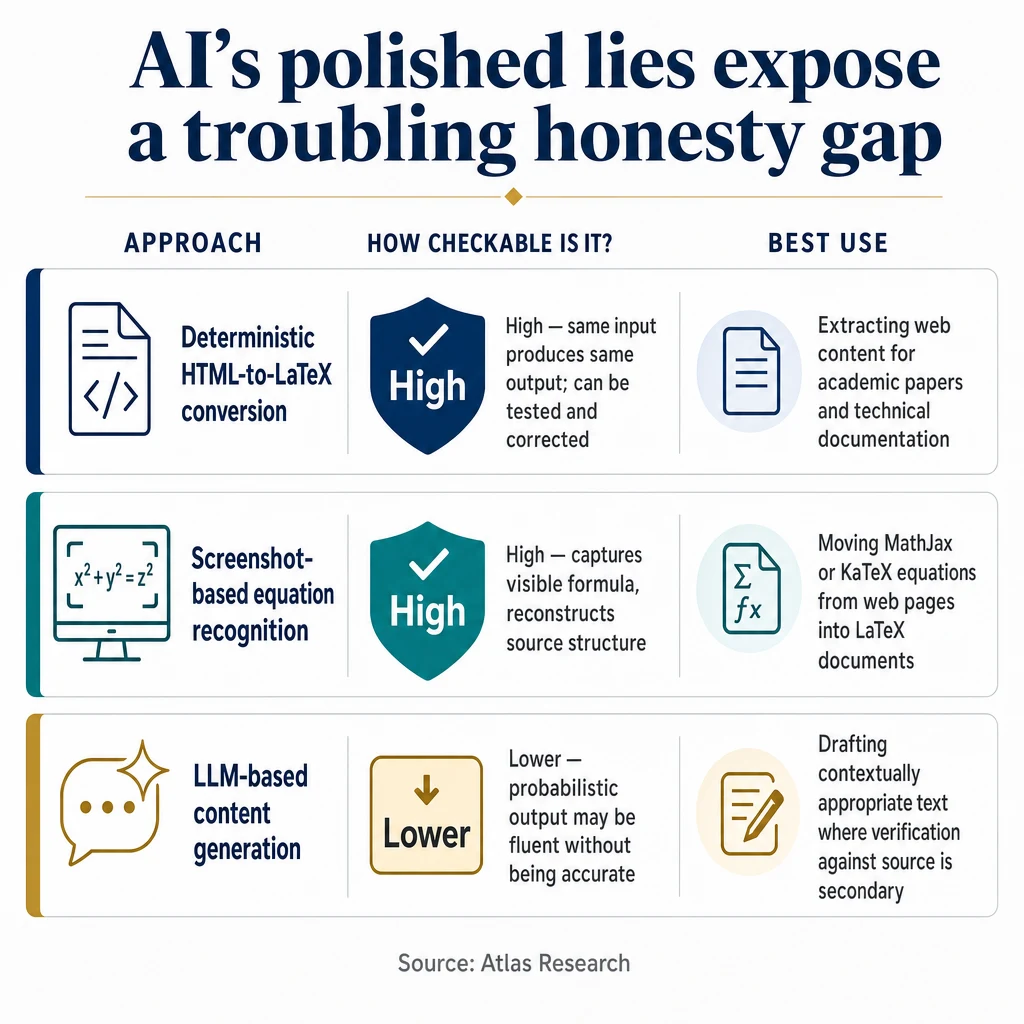
| Conversion Approach | Verifiability | Best Use Case |
|---|---|---|
| Deterministic HTML-to-LaTeX conversion | High same input produces same output; can be tested and corrected | Extracting web content for academic papers and technical documentation |
| Screenshot-based equation recognition | High captures visible formula, reconstructs source structure | Moving MathJax or KaTeX equations from web pages into LaTeX documents |
| LLM-based content generation | Lower probabilistic output may be fluent without being accurate | Drafting contextually appropriate text where verification against source is secondary |