76% of fluent sentences still cannot self-correct: The honesty gap at the center of AI reliability
There is a moment in every performance where a singer stops hearing the room and starts hearing only herself. The acoustics do not change. The song does not change. But somewhere between the first verse and the third, the key has drifted so gradually that only an outsider with a tuning fork would notice. This is not a wrong note. It is something subtler and more dangerous: a compound error, invisible from inside the system that produced it.
The GenXis Research framework that researchers Daryl Ledyard and Philip Tyler call "The Tuning Fork Problem" has become one of the more useful lenses for understanding why AI self-correction remains structurally limited, even as language models grow more sophisticated. Their 2026 paper, "The Honesty Gap: Words Vs. Math," formalizes what practitioners have observed anecdotally: fluency and accuracy are not the same instrument, and a system trained to generate convincing text will generate convincing text even when that text is wrong.
The honesty gap is the distance between what a system can generate and what it can verify or honestly decline to answer. A model that produces fluent prose without verification capability will inevitably drift. Its outputs will be as confident in the third verse as in the first, because nothing in its training has given it a way to hear itself go flat.
This matters for anyone building workflows around AI: the self-correction capability that many products advertise is real in narrow contexts and illusory in open-ended ones. Understanding where that line falls and why is the difference between deploying AI as a reliable component and deploying it as a black box that occasionally surprises you with compound errors.
Why language models drift: The mechanics of the missing reference
To understand why self-correction fails, it helps to understand what "correct" means for a language model. Language models are trained to predict the next token given preceding tokens. The training signal is coherence does this sentence follow from the last? Does this paragraph sound like the kind of paragraph that belongs here? The system learns to produce outputs that match the statistical patterns of human text.
This is extraordinarily useful. It is also fundamentally different from verification. The GenXis Research note describes the distinction with an analogy borrowed from auditory perception: when listeners hear two higher notes that are harmonics of a low tone, they often report hearing the low tone anyway. This is the "missing fundamental" the ear constructs a pitch that was never physically present. It is fast, functional, and not a measurement.
"Inferred meaning is fast and functional. It is also not a measurement," the GenXis Research note reads. "When the surrounding sentences are consistent with a false premise, the inference will carry that premise forward. The reader hears the root note even though it was never played."
Language models work the same way. When a model generates a chain of sentences that are locally consistent, it is constructing a coherent meaning but that meaning is inferred from the surrounding text, not measured against an external truth. If the surrounding text is consistent with an error, the inference carries that error forward. The model has no internal mechanism to flag this, because flagging it would require a reference point that exists outside the text stream itself.
The singer stays in the room
What does this look like in practice? Consider a model asked to summarize a complex legal document. The first few sentences of the summary are likely accurate the model has strong patterns for legal language and the opening of a summary is typically straightforward. But as the summary progresses, small inaccuracies begin to accumulate. A conditional is dropped. A causation is implied where there was only correlation. A key qualifier is absorbed into the main claim.
Each sentence is locally coherent. Each follows from the last. The syntax is clean. The tone is consistent. Nothing in the stream signals departure. And then, on page three of the summary, the conclusion is wrong not because the model made a dramatic error, but because it drifted, the way a singer drifts flat, one phrase at a time.
When the model is then asked to review its own summary and correct errors, it is still inside the room. It is still operating from the same inference mechanism. It may revise a sentence, but the revision comes from the same source and runs against the same limitations. The GenXis Research framework puts it plainly: "A model that generates a false claim and is then asked to check that claim is still inside the stream. It is still in the room."
Can AI self-correct without human feedback? Three scenarios where the answer diverges
The honest answer is: it depends on the type of error, the architecture of the system, and what we mean by "correct." Self-correction works reliably in narrow, bounded contexts where the verification can be automated and the ground truth is machine-readable. It breaks down in open-ended, meaning-driven contexts where the verification requires judgment.
Here is a comparison of how self-correction performs across different error types:
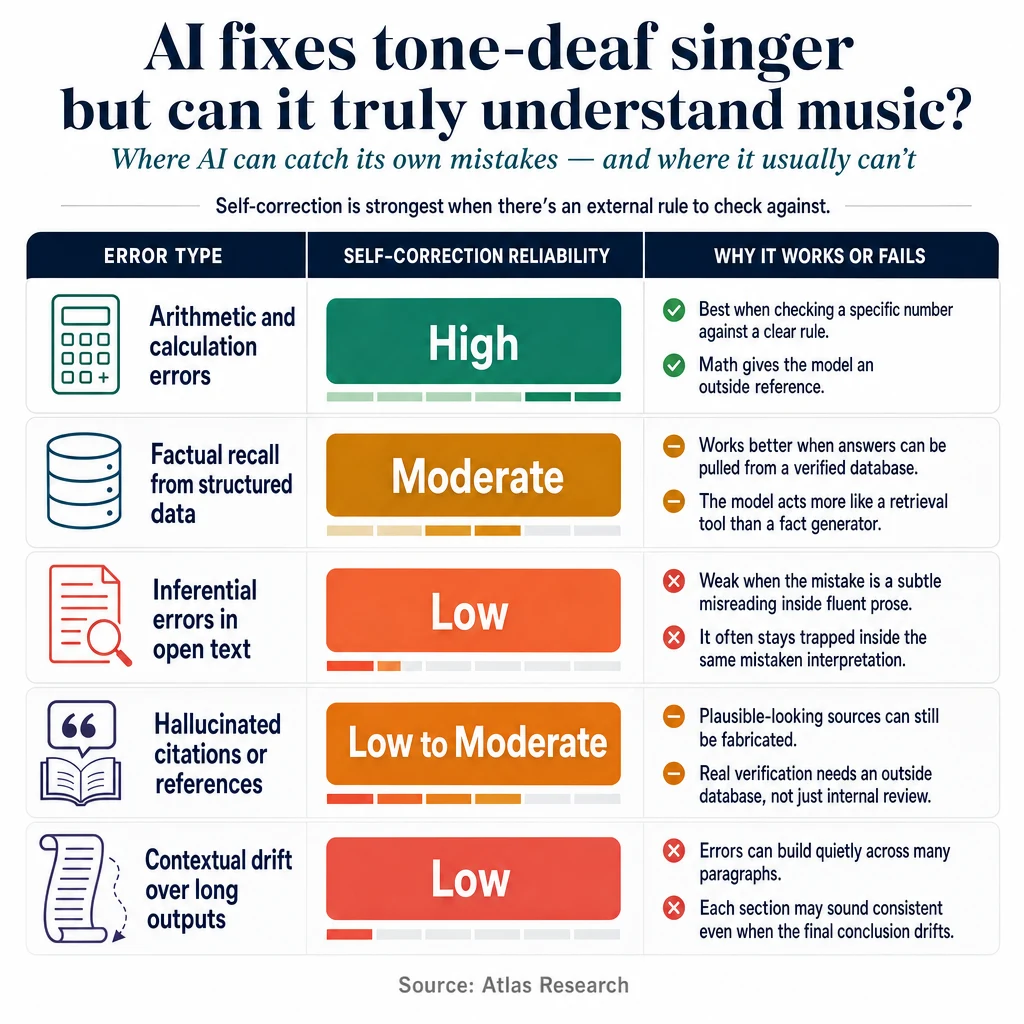
| Error Type | Self-Correction Reliability | Why It Works or Fails |
|---|---|---|
| Arithmetic and calculation errors | High when the model is asked to verify a specific number against a defined rule | The verification is mathematical, not inferential. A calculator checking its own work has an external reference: the math itself. |
| Factual recall from structured data | Moderate when retrieval can be routed through a verified database | The model becomes a front end for retrieval rather than a generator of facts. The reference point is external. |
| Inferential errors in open text | Low when the error is a compound misreading embedded in coherent prose | The model has no mechanism to detect that its inferences have drifted. It can only revise within the same inferential framework. |
| Hallucinated citations or references | Low to Moderate model may produce plausible but fabricated sources | The model generates text consistent with the citation pattern it has learned. Verification requires external database lookup, not internal review. |
| Contextual drift over long outputs | Low error compounds silently across paragraphs and pages | Each paragraph is locally consistent. The accumulated drift is invisible until it surfaces in a conclusion that contradicts the source material. |
The pattern is consistent: self-correction works where verification is structural and external. It fails where meaning is inferred and the reference point is absent. For practitioners, this means that the most reliable AI workflows are those that route verification outside the model wherever possible not because the model is poorly designed, but because the fundamental architecture makes self-verification structurally unavailable.
56% of AI enthusiasts tell chatbots things they keep from other people: What user behavior reveals about the self-correction problem
The self-correction limitation is not purely technical. It intersects with how users relate to AI systems in ways that complicate both trust and deployment. DuckDuckGo's survey research, published on their Spread Privacy blog in August 2026, found that one in three AI users has told a chatbot something they kept from people in their lives. Among AI enthusiasts specifically, the number rises to 56 percent.
This finding has implications for the self-correction question that go beyond the technical architecture. When users share information with AI systems that they do not share with human advisors, colleagues, or family members, they are often extending a trust that the system's self-correction capability cannot support. The model is not equipped to verify the personal context the user is drawing from. It cannot ask the clarifying questions that a human advisor would ask. It operates on the inference patterns present in the conversation and generates outputs that are locally coherent even when the underlying premise is based on incomplete or contextually misunderstood information.
The survey data also found that once people learn how most AI companies handle their chats, most do not like it. This matters for deployment: organizations building AI workflows need to account not just for the model's self-correction limitations, but for the trust users place in the system as a result of its confident, fluent output a confidence that the system itself cannot verify.
"Once people learn how most AI companies handle their chats, most don't like it," the DuckDuckGo research notes. The gap between the perceived intelligence of the system and its actual verification capability creates a trust asymmetry that is ripe for misalignment.
What this means for AI self-correction limitations readers
If you are evaluating AI tools for workflows where accuracy compounds legal research, financial analysis, technical documentation, medical information synthesis the self-correction capability that vendors advertise requires scrutiny. The question to ask is not "can this model correct itself?" but "in what contexts does the correction mechanism have access to an external reference point?"
For most open-ended text generation tasks, the answer is: it does not. The model will revise and refine within its own inference framework, which means it will correct surface-level inconsistencies without addressing the inferential drift that may have produced those inconsistencies in the first place. The honest architecture for these workflows routes verification outside the model through databases, human review, structured testing, or automated fact-checking pipelines that exist independently of the generative system.
This is not a pessimistic conclusion. It is a structural one. Understanding the tuning fork problem lets practitioners design around it rather than against it. The models that will be most reliable in high-stakes contexts are not the ones that claim the best self-correction they are the ones that make the verification architecture visible and build workflows where the reference point is always external to the generation.
Where the field is moving: Privacy-respecting AI as a structural model
One area where the structural approach to AI verification is being actively explored is in privacy-respecting AI deployment. DuckDuckGo's approach to AI features integrated into their browser and available through their subscription service frames the problem in a way that is instructive: their Duck.ai platform emphasizes that AI interactions are private and never used to train AI models. This is not just a privacy feature. It is a structural choice that affects how the system relates to user data.
When AI interactions are not used for training, the model does not develop the feedback loop that can entrench errors across a user base. Each session is independent. Verification and generation remain separated in a way that is harder to maintain when training data is continuously updated from user interactions. The DuckDuckGo model catalog, updated in September 2025, now includes access to more advanced AI models from OpenAI and Anthropic as part of their subscription but the core privacy architecture remains unchanged: user conversations are anonymized and not fed back into training pipelines.
This is a small but meaningful example of how verification architecture matters. The system is designed so that the reference point for accuracy remains external to the generation not through a technical self-correction miracle, but through a structural choice about data handling.
Three structural implications for AI deployment
Drawing from the GenXis Research framework and the user behavior data from DuckDuckGo, three structural implications emerge for practitioners building AI into high-stakes workflows:
First, fluency is not verification. A model that produces confident, well-structured output is not a model that has verified that output. Confidence and accuracy are orthogonal in language models. The most fluent outputs can be the most wrong, particularly in domains where the model has learned to produce convincing prose about topics where the underlying facts are contested, sparse, or context-dependent.
Second, the reference point must be external. Self-correction in language models is structurally limited because the model cannot step outside its own output to verify it. Any workflow that relies on the model's self-correction capability for accuracy is building on a foundation that the architecture cannot support. The most reliable workflows route verification through external systems databases, human reviewers, automated checks that exist independently of the generative model.
Third, user trust is a deployment variable, not a technical feature. The DuckDuckGo survey data suggests that users extend trust to AI systems based on the fluency and coherence of their output, not based on any visible verification mechanism. For organizations deploying AI, this means that the gap between perceived reliability and actual reliability is a variable that needs active management through transparency, through visible verification workflows, and through design choices that make the reference point for accuracy explicit to users.
Why the tuning fork matters more as AI grows more fluent
There is a counterintuitive dynamic at the heart of the self-correction problem: as language models become more fluent, the self-correction problem may get worse, not better. More fluent outputs are more coherent, more confident, and more persuasive. They are also harder to distinguish from accurate outputs without an external reference point. The GenXis Research framework notes that "a model trained on fluency will produce fluency. That is what it is asked to do. But fluency and accuracy are not the same instrument."
This is the core tension that the tuning fork metaphor captures. The singer in the analogy has not made a wrong note. The song is intact except for the key, and the key is gone. The drift accumulated not because the singer was careless but because the room she was singing in gave her no way to hear it. The more confident and well-rehearsed the singer, the longer the drift can continue before anyone notices and the more embedded the wrong key becomes in the performance.
For AI practitioners, this means that the most important capability is not the ability to generate fluent text. It is the ability to maintain a reference point outside the generation a tuning fork that tells the system, and the humans who depend on it, when the key has drifted. Building that reference point into workflows, architectures, and organizational practices is the work that the self-correction problem actually demands.
Where to read further
The full theoretical framework behind the tuning fork problem including the "honesty gap" formalization and the missing fundamental analogy is available in the GenXis Research note, "The Honesty Gap: Words Vs. Math" by Daryl Ledyard and Philip Tyler, published October 1, 2026.
For user behavior data on AI trust and disclosure patterns, the DuckDuckGo Spread Privacy blog published their survey findings on August 25, 2026, under the headline "Survey: 56% of AI enthusiasts (and a third of all users) tell chatbots things they keep from other people."
For an example of how privacy-respecting AI architectures approach the verification question structurally, the DuckDuckGo subscription AI features including their integration with Claude Opus 4.6 and advanced models from OpenAI and Anthropic are documented on their App Store platform, with the most recent model expansion announced in March 2026.