There is a painting by Jean-Michel Basquiat from 1981. It depicts a skull. Another from 1982 shows a devil. A third from the same year features the outline of a face. All three are extraordinary. All three share the same title: Untitled.
Across the history of contemporary art, some of the most provocative, moving, and expensive works ever created carry no name at all. The choice is not an oversight. It is, increasingly, a statement.
To understand why, it helps to look at how the convention of the untitled work has evolved from the white cube of the gallery to the web apps of Brooklyn, from the River North neighborhood of Chicago to the design studios where Figma component libraries take shape. The journey reveals something unexpected: the most loaded word in the creative vocabulary is often the one that says nothing at all.
The Weight of an Empty Field: Untitled Artworks Across Six Decades
According to the comprehensive Wikipedia's documentation of the term, "Untitled" has served as the official title for artworks across more than a dozen major artists and movements. The convention predates contemporary art by centuries, but its modern deployment carries specific conceptual weight.
The list is remarkable in its breadth. Francis Bacon created an Untitled panel painting around 1954. Keith Haring produced an Untitled work in 1982. Félix González-Torres made "Untitled" (Perfect Lovers), a 1987-1990 and 1991 found object sculpture, alongside "Untitled" (Portrait of Ross in L.A.) from 1991. Ellsworth Kelly installed an Untitled steel sculpture in Washington, DC in 1986. Donald Judd's Untitled (1967 Judd sculpture) sits in Indianapolis. Tom Hardy created an Untitled fountain and sculpture in 1952.
What connects these works is not style, medium, or period it is the deliberate refusal to name. In each case, the artist chose to let the work speak without the scaffolding of language that a title provides.
What Untitled Means in Contemporary Art
The artistic rationale for untitling work is multifaceted, and the Wikipedia source documents several traditions. Some artists use "Untitled" to resist the interpretive direction that a specific title imposes on viewers. Others employ it as a formal gesture a way of acknowledging that the work exists in a space before language, or that language itself is insufficient to capture what the work does.
In the case of González-Torres, whose works often dealt with intimacy, loss, and public space, the untitled works carried additional significance. "Untitled" (Portrait of Ross in L.A.) consisted of an arrangement of candies wrapped in gold cellophane, weighing the same as the artist's partner who had died of complications from AIDS. The absence of a traditional title was itself a form of memorial a refusal to frame grief within language when the work itself was the more honest vessel.
For Basquiat, whose untitled works from the early 1980s have sold for millions at auction, the practice may have reflected a different set of concerns. Many of these paintings emerged during an intensely productive period when Basquiat was navigating questions of identity, power, and cultural ownership. An untitled work by Basquiat carries different meanings than the same visual content would under a named title it becomes less a story told by the artist and more a confrontation left for the viewer to resolve.
From Canvas to Cloud: How the Convention Migrated to Digital Culture
The untitled convention did not stay in galleries. As digital tools became extensions of creative practice, the concept migrated into new contexts often with deliberately different implications.
Consider Untitled UI, a Figma UI kit and React component library that has become one of the most widely adopted design resources in the technology industry. According to the product's own documentation, more than 380,000 designers have adopted the platform. The Untitled UI website describes the library as "the ultimate UI kit and design system for Figma" and notes that it has expanded to include what they describe as "the world's largest collection of React components."
The choice of "Untitled" as a brand name in this context is revealing. Unlike the art world, where the untitled work carries philosophical weight about interpretation and authorial intent, the design world adopted the term for practical reasons. In user interface design, components are meant to be neutral vessels containers for content that will be determined later. An "Untitled" button component, an "Untitled" modal, an "Untitled" form field: these are design scaffolds, not artistic statements. The name communicates that the component is a placeholder, waiting to be filled with specific purpose.
This dual existence philosophical provocation in one domain, practical placeholder in another reveals something important about the word "Untitled" itself. It is not a single concept but a family of related practices, each with its own logic and community of users.
The Brooklyn App That Made Unfinished Music Its Purpose
Nowhere is this more evident than in the world of music, where the relationship between finished and unfinished work has always been complicated. A platform called [untitled] described on its website as "a sacred place for your work-in-progress music" was built specifically to serve musicians who resist the pressure to finalize their creative work before sharing it.
The platform, which was developed in Brooklyn, NY, offers tools for uploading, organizing, sharing, and collaborating on musical sketches, experiments, and compositions that exist in intermediate states. According to the service description, users can "upload directly from Airdrop, Files, iMessage or anywhere you're getting sent music" and can "listen, edit, and organize no matter your internet connection with offline mode."
For these musicians, the question of what to call a piece of work-in-progress is not trivial. A traditional title imposes a kind of closure it says "this is what this is." By building a platform specifically for untitled work, [untitled] has created an infrastructure for the creative process itself, separate from the artifacts of completion.
The platform's emphasis on security they note having "partnered with a world-class cybersecurity firm" and that their "encryption is on par with Dropbox and SoundCloud" reflects the intimacy of sharing unfinished work. For musicians in this space, the untitled state is not a failure to finish but a deliberate choice to share process rather than product.
Hospitality and the Theatrical Unnamed
The convention extends even further afield into the hospitality industry, where the question of naming carries commercial as well as aesthetic implications.
The Untitled Supper Club in Chicago occupies 18,000 square feet across multiple levels in the city's River North neighborhood. According to the venue's official description, it is "a 1920s Prohibition-era inspired restaurant, bar, and live entertainment venue" designed "to evoke the glamour and indulgence of the Roaring Twenties." The space features what they describe as "one of the largest selections of American whiskey in the world" and hosts live music, jazz ensembles, burlesque performances, and cabaret-style shows on a weekly basis.
Here, the choice of "Untitled" serves a different function again. The supper club's website frames it as theatrical a name that suggests invitation without prescription, a space where identity is fluid and experience is primary. The word becomes a kind of promise: come as you are, without the need to perform a specific version of yourself.
The venue's approach to dress code reflects this philosophy. Their website quotes Diana Vreeland: "You gotta have style. It helps you get down the stairs." But they impose specific requirements no t-shirts, baseball hats, shorts, sandals, or gym shoes creating a framework for the evening while maintaining an openness about what kind of style that might mean for each individual guest.
Operating hours span from 5pm to midnight on weeknights and extend to 3am on Saturday, the venue transforms dinner into what they describe as "a full evening of immersive nightlife." The Untitled Supper Club has become one of Chicago's most distinctive nightlife destinations a space where the absence of a specific name or theme allows the programming itself, and the guests, to define the experience.
Entertainment Management and the Brand of Anonymity
In the entertainment industry, the stakes of naming and identity take yet another form. Untitled, an entertainment management company, has operated for more than 25 years as a leading management company representing voices in film, television, theater, fashion, digital media, and music.
According to the company's official about page, Untitled "represents some of the most influential and celebrated voices across film, television, theater, fashion, digital media, and music." The company is part of Initial Group, a TPG-backed global entertainment company, and maintains offices in Los Angeles, New York, and London.
The choice of "Untitled" as a brand name in this context is notable. Unlike the artistic practice, where the untitled work refuses to interpret itself, an entertainment management company using the name is making a different kind of statement suggesting flexibility, potential, a capacity to represent any kind of talent rather than a specific aesthetic or genre.
Over 25 years of operation, the company has built what its about page describes as "a track record spanning over 25 years" during which they have provided "comprehensive, creative, and strategic partnership to individuals and companies whose work defines what we see, hear, and share." The name becomes a kind of blank canvas for the identities of the talent they represent.
Untitled Across Disciplines: A Comparison
The following table maps how the "Untitled" convention operates differently across four distinct creative and commercial domains:
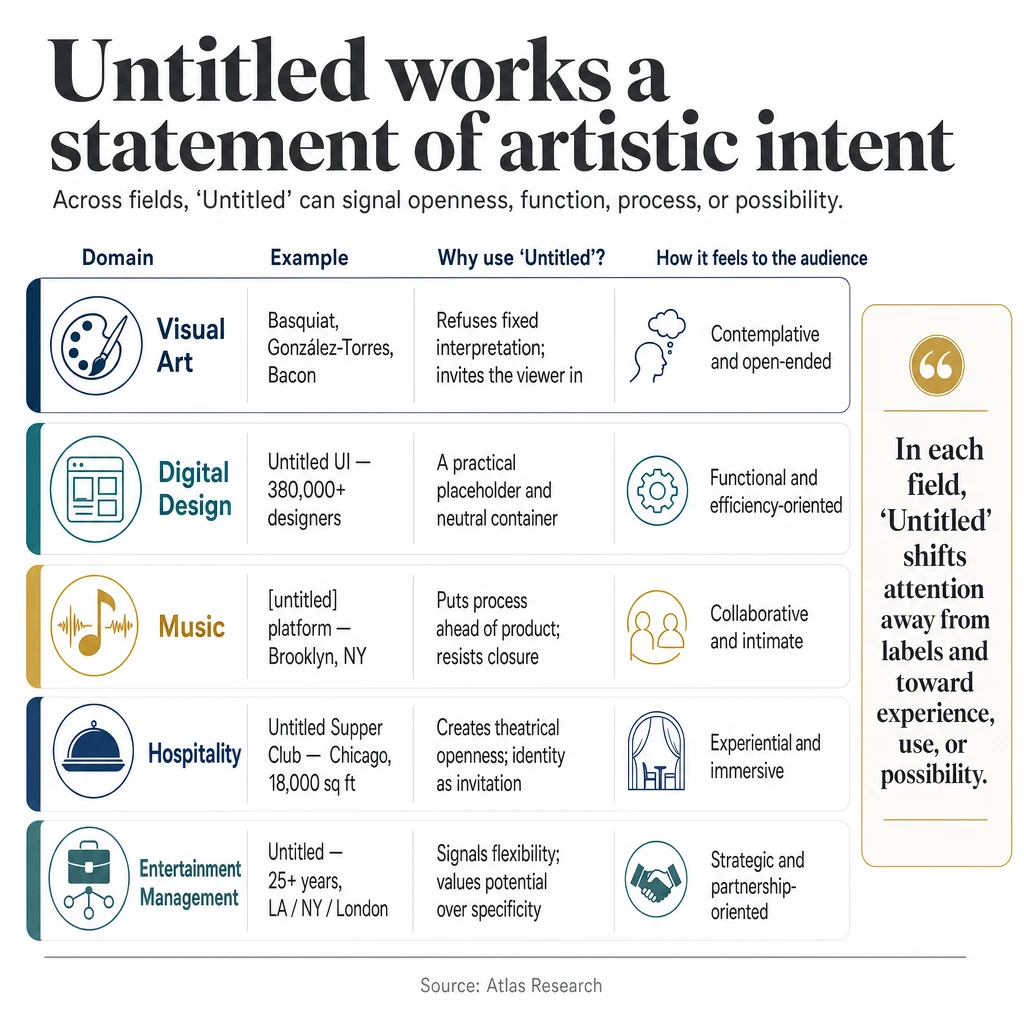
| Domain | Example | Primary Function of "Untitled" | Audience Relationship |
|---|---|---|---|
| Visual Art | Basquiat, González-Torres, Bacon | Philosophical refusal to interpret; invitation to viewer | Contemplative, open-ended |
| Digital Design | Untitled UI (380,000+ designers) | Practical placeholder; neutral container | Functional, efficiency-oriented |
| Music | [untitled] platform (Brooklyn, NY) | Process over product; refusal of closure | Collaborative, intimate |
| Hospitality | Untitled Supper Club (Chicago, 18,000 sq ft) | Theatrical openness; identity as invitation | Experiential, immersive |
| Entertainment Management | Untitled (25+ years, LA/NY/London) | Flexibility; potential over specificity | Strategic, partnership-oriented |
What This Means for The Beast Readers
The evolution of "Untitled" from art-world convention to multi-industry practice offers several lessons for readers working across creative disciplines.
First, the meaning of "Untitled" is not fixed but negotiated. In every domain, the choice carries specific implications that reflect the values and needs of that community. Artists use it to resist interpretation. Designers use it to denote flexibility. Musicians use it to emphasize process. Hospitality venues use it to invite identity play.
Second, the proliferation of "Untitled" across digital platforms reflects a broader cultural shift toward valuing work-in-progress and process over finished artifacts. Platforms like [untitled] built specifically for sharing unfinished musical work suggest that the untitled state is becoming its own creative category, not merely a transitional phase between creation and completion.
Third, for practitioners in any creative field, the decision of whether to title work is itself a creative act. The sources document that this choice has been made deliberately and meaningfully by some of the most significant figures in contemporary art, music, and design. It is not a default but a decision and understanding the range of meanings that decision can carry enriches one's own practice.
The Strategic Deep-Dive: Why This Matters Now
In an attention economy that increasingly rewards clarity, brevity, and instant legibility, the persistent presence of "Untitled" across creative industries is counter-intuitive. Shouldn't everything need a name to be found, shared, and remembered?
The evidence suggests otherwise. The artists who have chosen untitled works from Bacon to Basquiat to González-Torres have not suffered for the choice. If anything, the ambiguity has deepened the impact of their work, inviting viewers to bring more of themselves to the encounter.
The same pattern appears in digital culture. Untitled UI has become a standard tool for 380,000 designers not despite its generic name but in part because of it. The name communicates neutrality, utility, and flexibility exactly what a component library needs to communicate. In this context, "Untitled" is not an absence but a positive statement about what the tool is for.
For practitioners, the lesson is clear: titling decisions are creative decisions. Whether to name a work, leave it untitled, or use a placeholder like "Untitled" as a deliberate final choice are all meaningful options, each with its own implications for how the work will be received, shared, and remembered.
Finding Your Own Relationship with the Unnamed
The journey from the white cube to Brooklyn studios to Chicago nightlife venues reveals a consistent pattern: the most thoughtful practitioners in each field have engaged deliberately with the question of naming. They have not treated titles as afterthoughts or defaults.
For artists, this might mean sitting with the question of whether a title serves the work or constrains it. For designers, it might mean developing conventions for how to use "Untitled" as a meaningful state in design systems. For musicians, it might mean exploring platforms like [untitled] that validate the creative value of work in progress. For anyone building a brand or venue, it might mean considering what an open name like "Untitled" communicates about flexibility and invitation.
The word "Untitled" has meant so many things across so many disciplines that its very ambiguity has become a resource. In a world that increasingly demands we name everything, the choice to leave something unnamed carries weight philosophical, practical, or both. Understanding that weight is the first step toward using it deliberately.
Where to Read Further
For readers interested in exploring the artistic tradition of untitled work in depth, the Wikipedia documentation of untitled artworks provides a comprehensive catalog spanning multiple artists, periods, and movements.
Musicians interested in the work-in-progress approach may find the [untitled] platform described as "a sacred place for your work-in-progress music" and developed in Brooklyn, NY a useful resource for sharing and organizing unfinished creative work.
For practitioners in digital design, Untitled UI offers an extensive library of Figma components and React components that demonstrates how the untitled convention operates in technology contexts.
Those interested in the hospitality industry's use of open naming conventions can explore the Untitled Supper Club's approach to creating immersive entertainment experiences in Chicago's River North neighborhood.