


There's a version of the AI-lead-generation story that sells itself in conference keynotes: the machine finds your leads, qualifies them, writes the emails, books the meetings, and your sales team just shows up to close. That version is not true. It never was. And the practitioners who built the real AI-powered lead generation systems available today will tell you so plainly, if you ask them the right questions.
The contrarian position worth taking and the one supported by how the actual tools function is this: AI doesn't replace the sales process. It eliminates the administrative labor that was suffocating it. The moment you stop expecting AI to think like a salesperson and start expecting it to work like a research assistant who never sleeps, the numbers change. The pipeline fills differently. The rep who used to spend three hours building a prospect list now spends those three hours on a call that closes.
This is the practitioner's perspective on AI-powered sales lead generation grounded not in hypotheticals but in the specific mechanics of tools like the BulkLeads platform, which bundles ten AI-powered functions into a single pipeline. It's a workflow story, not a magic story. And that's exactly why it works.

What AI-Powered Lead Generation Actually Means in Practice
The phrase "AI-powered lead generation" gets used so broadly that it risks becoming meaningless. Some sellers hear it and assume the system will somehow intuit who their best customers are. Others assume it means buying a pre-built database of names and calling it done. Both assumptions miss the actual mechanism.
In the platforms that define the current generation of AI sales tools including the ten-function suite available through BulkLeads the technology handles three distinct categories of work that used to require human time:
- Data extraction: Pulling contact information, social media profiles, phone numbers, and firmographic details from lists of websites or companies, automatically, at scale.
- Lead enrichment: Taking a partial list of contacts and filling in the missing fields missing emails, job titles, company data, domain information using pattern recognition and verified data sources.
- Automated initial contact: Deploying chatbots, email sequences, and social proof notifications that engage visitors and prospects before a human ever enters the conversation.
The BulkLeads platform, for instance, includes a Data Extractor tool that pulls emails, phone numbers, and social URLs from lists of domains, generating downloadable Excel reports in minutes rather than the hours a researcher would need. Their Email Finder tool constructs probable email addresses from a contact's first name, last name, and company domain a task that previously required either expensive manual research or purchased databases of unknown accuracy.
This is not artificial general intelligence. This is narrow, repeatable automation with pattern-matching capabilities. The distinction matters because practitioners who understand it deploy the tools where they create leverage, while practitioners who expect broader intelligence waste budget trying to automate tasks the technology wasn't built for.
The Consensus Worth Challenging: "AI Replaces the Salesperson"
The dominant narrative in B2B sales technology right now positions AI as a replacement for human salespeople or at minimum, as a system that dramatically reduces headcount requirements. Vendors of varying credibility promote the idea that AI-powered lead generation means fewer reps needed, faster cycles, and near-autonomous pipeline generation.
The evidence from how practitioners actually use these platforms tells a different story. AI tools, as they're currently designed, don't eliminate the human in the sales process. They eliminate the research phase that was blocking the human from doing what they're actually good at.
A sales rep who receives a pre-qualified list of leads with verified emails, enriched company data, and automated chatbot responses capturing interest signals is not a redundant employee. That rep is a salesperson who can finally sell. The three to four hours per day that used to vanish into spreadsheet research now become three to four hours of actual conversation the part of the job where judgment, relationship-building, and deal-closing happen.
The BulkLeads pricing model reflects this reality. The platform is priced per user at $49 per month for a single-user Business Plan, with an Enterprise option at $99 per month covering five users. The model assumes ongoing human users the AI tools don't operate autonomously but are accessed and directed by sales professionals. The "unlimited" features (unlimited enrichment queries, unlimited email sends, unlimited chatbot installations) are designed to serve human workflows at scale, not to eliminate the human.
How AI Improves B2B Sales Lead Generation: The Practitioner View
Practitioners who have integrated AI into their B2B lead generation workflows consistently report improvements in three specific areas: speed, data quality, and follow-up consistency. Each of these was a persistent failure point in traditional outbound sales processes.
Speed: From Days to Minutes
The traditional lead research workflow looked something like this: a sales rep identifies a target company, searches for the company's website, navigates to their contact or about page, identifies potential decision-makers, attempts to construct or guess their email format, cross-references LinkedIn for verification, and then moves to the next company. For a list of two hundred targets, this could consume an entire week of a rep's time before a single email was sent.
The AI-powered equivalent, using tools like the BulkLeads Data Extractor and Email Finder, runs as follows: upload a list of two hundred domains or import a CSV of contact names and company names. The system extracts, builds, and verifies email addresses automatically. A downloadable report is ready within minutes. The rep reviews the results, adjusts targeting if needed, and begins outreach the same day.
For a B2B practitioner managing an outbound pipeline, this compression of the research phase from days to minutes is not a marginal improvement. It fundamentally changes how many prospects can be touched per week. A rep who previously worked a list of fifty companies per week can, with AI assistance, work a list of two hundred and spend the additional time on the follow-up calls and personalized outreach that actually converts.
Data Quality: Verified, Not Guessed
Traditional lead generation methods suffered from a persistent accuracy problem. Email databases purchased from third-party vendors were frequently outdated addresses had changed, employees had departed, domains had shifted. Cold email campaigns built on guessed email formats (first.last@company.com) landed in spam folders at high rates, damaging sender reputation before the campaign had a chance to succeed.
AI-powered tools address this differently. The BulkLeads Email Verifier API, for instance, is described as designed to prevent fake emails and block disposable email addresses at registration a quality-control function that protects the integrity of your prospect database from the moment data enters the system. The Email Finder tool builds addresses from verified patterns, not assumptions, and the enrichment layer adds firmographic context (company size, industry, location) that allows for more intelligent qualification before human outreach begins.
The practical impact on B2B sales is measurable in deliverability rates and meeting conversion. A campaign sent to a verified, enriched list performs differently than a campaign sent to a guessed list. The AI tools don't guarantee the meeting that still depends on messaging, timing, and the rep's skill. But they remove the variable of bad data as a reason for failure.
Follow-Up Consistency: The Automation Layer
One of the most persistent failure modes in outbound sales is not the initial outreach it's the follow-up. Research consistently shows that most deals require five or more touchpoints before converting, yet most sales reps abandon follow-up after two or three attempts due to time constraints. The result: leads that were genuinely interested but not ready to buy on first contact get lost.
AI-powered sales sequence tools address this directly. The BulkLeads Email Sequences feature is described as enabling sales cadence and newsletter campaigns with unlimited emails to send, running on the user's own SMTP. This allows a single rep to run multi-touch sequences across hundreds of prospects simultaneously the system handles the timing and delivery while the rep focuses on replies, objections, and meetings.
The chatbot layer compounds this further. The BulkLeads Chatbot solution captures and converts visitors into leads automatically, engaging website visitors in real-time conversations, collecting contact information, and routing qualified leads directly into the rep's workflow via email, SMS, or Slack. A visitor who lands on your site at 11 p.m. and submits a query doesn't wait until 9 a.m. for a response the chatbot engages, qualifies, and captures the lead while the interest is active.
Is AI Lead Generation More Effective Than Traditional Methods? The Honest Practitioner Answer
The question is sometimes framed as a competition: AI versus human-led research. That framing is wrong. AI-powered lead generation doesn't compete with traditional methods it absorbs them, automates the repetitive components, and frees the human to operate at a higher level of the sales process.
The evidence from practitioners who have made the transition is consistent: the efficiency gains are real, but they manifest as time reallocation rather than headcount reduction. A sales team of five using AI tools will generate more pipeline than a team of five using traditional methods but they'll generate it by spending their days differently, not by working fewer hours.
The comparison that matters is not AI versus human research. It's a human operating with AI assistance versus a human operating without it. The assisted version consistently outperforms. This is less a revelation than a recognition of what automation has done in every other industry the difference is that in sales, the human element (judgment, relationship, trust) remains central to the closing phase, so the AI augmentation is additive rather than substitutive.

The Practitioner Playbook: Integrating AI Into Your Sales Pipeline
For a B2B seller or marketing leader looking to integrate AI-powered lead generation tools into an existing pipeline, the practical sequence matters. Jumping directly to automated email sequences without first ensuring data quality will amplify your problems, not solve them. The right order of operations looks like this:
Step 1: Build a Clean Foundation with Data Extraction and Enrichment
Before outreach begins, your prospect data needs to be accurate and enriched. Use the Data Extractor tool to pull contact information from target company lists, then run the Email Finder to construct and verify addresses from names and company domains. Enrich the results with firmographic data company size, industry, registered domains to enable intelligent segmentation.
This step is where the time savings are most dramatic. A task that previously required a dedicated researcher or expensive purchased list is now accomplished in minutes by the sales rep who will actually use the data.
Step 2: Qualify and Route with Chatbots
Install a chatbot on your highest-traffic pages your pricing page, your contact page, your most-viewed content. Configure the scenario to capture key qualification signals (budget, timeline, use case) and route results directly to the rep's inbox or Slack channel. The chatbot doesn't replace qualification conversations it starts them, capturing intent data from visitors who might otherwise bounce and never return.
Step 3: Deploy Cadence Sequences with Verified Data
With clean, enriched, verified contact data loaded into your outreach system, launch a multi-touch email sequence. The cadence should account for the reality that most B2B buying decisions involve multiple stakeholders and extended consideration windows. Use the AI-assisted sequence tool to manage timing, follow-up triggers, and reply tracking while the rep focuses on personalized responses to engaged prospects.
Step 4: Capture Social Proof and Reviews
As your pipeline begins to generate customers, activate the social proof and review management tools. The BulkLeads Reviews tool generates automated requests to happy customers, directing them to leave reviews on Google, Yelp, and Facebook platforms where prospective buyers frequently research vendors before engaging. A strong review profile reduces the friction of new prospect decision-making and supports the later stages of the pipeline where trust is being established.
What This Means for BulkLeads Readers
For readers evaluating the BulkLeads platform specifically, the practitioner lens reveals a coherent design philosophy: the suite is built around the assumption that B2B lead generation is a multi-stage process requiring different tools at each stage, and that bundling those tools in a single platform reduces the friction of data handoffs between systems. The ten functions (Data Extractor, Email Finder, Email Verifier, Chatbot, New Leads Daily, Lead Enrichment, Email Sequences, Review Management, Social Proof Widget, and B2B Social Leads) cover the full arc from prospect identification through customer acquisition with the AI layer handling the repetitive work in the middle stages.
The pricing structure $49 per user per month for the Business Plan with unlimited access to all ten tools positions the platform as a per-seat productivity tool rather than a transactional data vendor. You're not buying a one-time list; you're subscribing to a workflow system that improves as your usage compounds.
Where the Human Judgment Stays Essential
To be clear about the boundaries of what AI-powered lead generation can do: the tools handle data gathering, initial qualification, and automated engagement. They do not handle the moments where deals are actually won or lost the conversations where a rep understands a buyer's specific objection, adjusts their pitch in real time, builds trust with a skeptical economic buyer, or navigates an internal consensus process at the prospect's company.
Those moments require judgment, empathy, and adaptability that current AI systems do not replicate. The practitioner who uses AI effectively is not one who outsources their sales process to automation it's one who uses AI to clear the time and improve the data quality so that their human skills have more room to operate. The AI is the research assistant; the rep is the closer. That distinction, not the fantasy of full automation, is where the real leverage lives.
Summary: The Practitioner Reality of AI-Powered Lead Generation
Here's what the evidence from practitioners and functional AI sales tools actually shows:
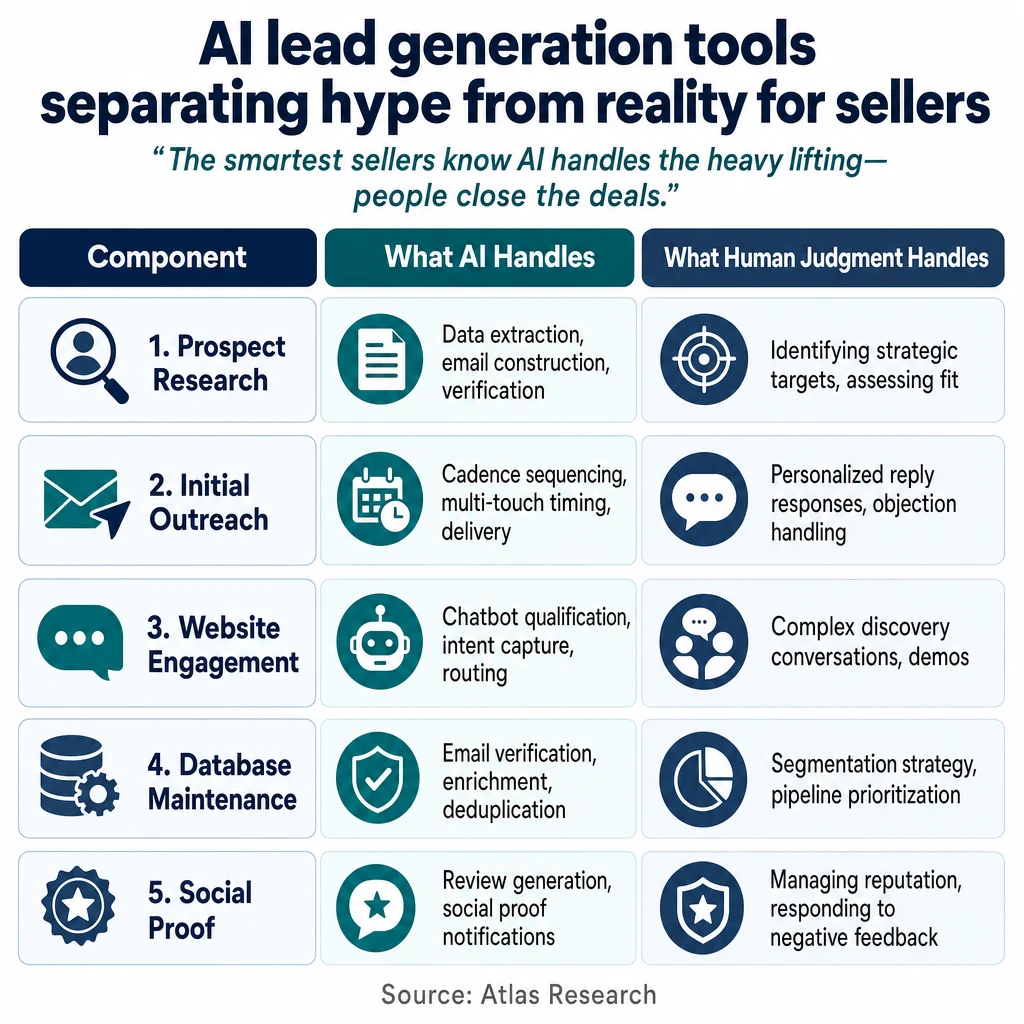
| Component | What AI Handles | What Human Judgment Handles |
|---|---|---|
| Prospect Research | Data extraction, email construction, verification | Identifying strategic targets, assessing fit |
| Initial Outreach | Cadence sequencing, multi-touch timing, delivery | Personalized reply responses, objection handling |
| Website Engagement | Chatbot qualification, intent capture, routing | Complex discovery conversations, demos |
| Database Maintenance | Email verification, enrichment, deduplication | Segmentation strategy, pipeline prioritization |
| Social Proof | Review generation, social proof notifications | Managing reputation, responding to negative feedback |
The AI does not replace the human. The AI amplifies the human. That's the practitioner truth and it's the reason the tools built for that reality, like the integrated BulkLeads suite of ten AI-powered tools, continue to gain adoption among B2B sales teams that have moved past the hype and into the workflow.
Where to Read Further
For practitioners who want to go deeper into the mechanics and comparative landscape of AI-powered B2B lead generation tools, the following resources offer substantive context:
- The BulkLeads platform overview provides detailed descriptions of each tool in the ten-function suite, including the Data Extractor, Email Finder, Chatbot, and Email Sequences capabilities that form the core of an AI-assisted pipeline.
- The BulkLeads pricing page offers current plan details, feature access by tier, and the unlimited-access model that supports high-volume outbound workflows.
- For a broader view of the lead-generation vendor landscape, the Salesgenie guide to buying business leads in 2025 compares over twenty providers, including their data coverage, pricing models, and feature trade-offs useful context for understanding where bundled AI suites fit relative to traditional list-purchase models.
The practitioner who reads widely, tests tools against their specific workflow, and maintains clear expectations about what AI can and cannot do will build the most effective pipeline. The tools are ready. The question is how well you deploy them.