


Late on a Thursday evening, a sales director at a mid-sized SaaS company stares at her screen. She has a list of 847 LinkedIn profiles she wants to reach decision-makers at manufacturing firms in the Midwest, pulled from a search she ran that afternoon. The problem: LinkedIn shows her their names, their titles, their companies. Not their email addresses. Not even close.
She could visit each profile manually. She could cross-reference against her CRM. She could spend $3,000 on a purchased list that will be 40% outdated within six months. Or she could try something else something that, three years ago, would have felt like a workaround, and today feels like infrastructure.
This is the quiet revolution happening in B2B email extraction. The tools have matured. The workflows have integrated. And the practitioners who once worried about legality, accuracy, and scale are now building entire outbound motions around these capabilities. The contrarian position isn't that extraction is dangerous or dishonest it's that the industry has grown up, and the old objections no longer hold.

The Shift from Scraping to Discovery
The language matters. "Scraping" implies aggression, violation, and risk. "Extraction" sounds clinical. But the tools in this space have increasingly moved toward what practitioners call discovery using AI to infer, verify, and enrich email addresses from professional signals beyond simply pulling them from a platform's database.
BulkLeads, for instance, describes its core capability as extracting B2B emails from social media and building targeted lists, but the actual workflow involves AI-powered verification, trust scoring, and export-ready formatting. The BulkLeads product page frames it this way: "Our system will help you to find leads based on job title, location, country, industry, and company size." That's not scraping. That's query-based discovery with intelligent filtering.
The distinction matters because it shapes how practitioners should think about the workflow. Modern tools don't just pull emails they verify them. Cap City Apps, another player in this space, offers what it calls "AI Verification" that helps clean email lists by identifying fakes, typos, and low-quality addresses. The Cap City Apps feature description includes "Assign trust scores to every contact" and "Block generic or catch-all domains." This is verification infrastructure, not extraction in the old sense.
How the Tools Actually Work
Understanding the mechanism helps dispel the mystery. Most B2B email extraction tools operate on a discovery model beyond a scraping model. Here's how it typically functions:
First, the user inputs search parameters job title, location, industry, company size. The tool searches professional social platforms and public business databases for matching profiles. Second, the system attempts to derive email addresses using known patterns: if you know someone's first name, last name, and company domain, you can often construct their business email using common formats (first.last@company.com, firstinitiallastname@company.com, etc.). Third, AI verification kicks in, checking whether the constructed email is valid, whether it belongs to the right person, and whether it's likely to receive messages.
Finaleads, another platform in this space, describes its approach as finding leads based on job title, location, country, industry, and company size, then pulling verified emails straight from social platforms. The Finaleads product description emphasizes "Create unlimited lists, filter by country, industry, size and job title" and "Hyper targeted lead generation." The emphasis on filtering and targeting suggests a workflow that's more about precision than volume.
Riccastro takes a similar approach, offering what it calls "AI Email Finder" that finds emails from first name, last name, and company name. The Riccastro platform describes uploading a CSV with contact information and having the tool discover emails from email format patterns. "Find emails with just a name + company. Upload big batch of CSV online to find emails. Email discovery is fast and build emails from patterns."
The Verification Layer
What separates 2026 tools from their predecessors is the verification layer. Earlier extraction tools often produced lists with 30-40% bounce rates. Modern platforms claim significantly higher accuracy. BulkLeads offers "AI technology helps you clean your email list by identifying fakes, typos, and low-quality addresses." The platform assigns trust scores to every contact and can block generic or catch-all domains that would otherwise inflate bounce rates.
This verification capability matters for deliverability. According to HubSpot, there are 4 billion daily email users, and effective B2B outreach depends on maintaining list hygiene. A 2026 comparison of B2B email list providers on Artisan's blog notes that "Your list should contain more than up-to-date prospect information. It should also include enriched data and seamlessly integrate with your sales tools, streamlining outbound sales and sales strategies."
The Legal Question: More Nuanced Than You Think
Ask most sales professionals about extracting emails from LinkedIn and you'll get a nervous laugh. "Isn't that illegal?" The honest answer is: it's complicated, and the common assumption of illegality is both too broad and too narrow.
Platform terms of service are not the same as law. LinkedIn's terms prohibit certain types of automated data collection, but violating a terms of service agreement is a contract issue, not a criminal matter. The legal landscape around web scraping has evolved through cases like hiQ Labs v. LinkedIn, which established that scraping publicly available data may not violate the Computer Fraud and Abuse Act. That doesn't mean all extraction is legal it means the question requires nuance more than blanket prohibition.
The practical reality is that thousands of businesses use these tools daily. BulkLeads notes on its product page that "Our product is used by thousands of companies and help them daily." Cap City Apps claims its products are "trusted by over 10,000 businesses worldwide." These aren't edge cases or gray-market operators they're mainstream B2B infrastructure.
What practitioners should understand is that the tools themselves have evolved to operate within legal boundaries. Modern extraction platforms don't typically instruct users to violate platform terms. They offer discovery workflows, verification systems, and enrichment capabilities that operate on public business information and constructed email patterns more than unauthorized database access.
Free Methods: What Actually Works
The question "how can I find B2B email addresses for free?" has a honest answer: you can, with significant limitations. Free methods exist, but they trade time for money and accept trade-offs in scale and accuracy.
Manual discovery remains viable for small-scale prospecting. If you need 10-20 email addresses for a targeted campaign, you can often find them through LinkedIn Sales Navigator (which shows some contact info), company websites (the "team" or "about" pages often list executives with email formats), and professional associations or conference attendee lists.
Browser extensions offer a middle ground. Tools like Hunter.io, Snov.io, and others offer free tiers with limited daily lookups. These work by finding email patterns from public web data more than extracting from social platforms directly. The limitation is volume you'll hit free tier caps quickly if you're running any meaningful outbound campaign.
Riccastro offers what it calls a "free forever version" with registration required. The Riccastro platform invites users to "Try the free version before you buy, start your trial now." This freemium approach is common in the space, allowing practitioners to test accuracy and workflow before committing to paid plans.
The contrarian insight here: free methods aren't necessarily worse than paid ones for small-scale use cases. If you need 50 verified emails for a regional campaign, the time cost of free tools might be acceptable. The value proposition of paid tools emerges at scale when you need 5,000 emails, when you need them verified, when you need them exported directly to your CRM.
When Free Becomes Expensive
Here's the calculation many practitioners miss: the true cost of free tools is time, not money. If a free tool requires 15 minutes to find and verify 10 emails, and a paid tool finds and verifies 500 emails in the same time, the "free" approach costs $7.50 per hour in lost productivity. At B2B sales rates, that math often favors paid tools.
BulkLeads' pricing, for instance, starts at $49 per month per user for the Business Plan, which includes unlimited enrichment features, unlimited exports, and unlimited access to extraction capabilities. The BulkLeads pricing page shows this covers "Unlimited B2B contacts extracted" and "Unlimited B2B visits & requests." For a sales team running regular outbound campaigns, that flat-rate pricing model makes the cost predictable and the ROI clearer than per-credit models.
Bulk LinkedIn Extraction: The Practical Reality
The question "how do you extract bulk emails from LinkedIn?" deserves a direct answer. LinkedIn is the dominant B2B social platform, with over 900 million professionals in its network, and it's often the first place practitioners look for prospect data. The workflow for bulk extraction has evolved significantly.
Modern tools don't typically extract directly from LinkedIn's database. Instead, they use LinkedIn as a search and discovery layer, then apply email discovery algorithms to the profiles and company information found there. You search LinkedIn for "VP of Operations at manufacturing companies in Ohio." You get 200 profile matches. You feed those names and companies into an extraction tool. The tool constructs likely email patterns and verifies them. You export the results.
Finaleads describes this workflow as "Get B2B leads directly from a search" and "Capture all the leads from a search." The Finaleads feature set includes "Automatic leads extraction from a search" and "Push directly leads to an emailing campaign." The integration between search, extraction, and campaign launch reflects how the workflow has matured from isolated tools to end-to-end pipelines.
The Scale Question
One of the persistent myths about B2B email extraction is that it doesn't scale that bulk extraction produces unusable lists. The evidence suggests otherwise, at least for modern platforms. Finaleads reports on its homepage that it processed 269,970 new domains and verified 13,003 business emails in a recent daily cycle. These aren't small numbers they represent industrial-scale operations that have moved well beyond manual processes.
The verification layer is what makes bulk extraction viable. Without trust scoring, pattern matching, and catch-all domain blocking, bulk lists would produce high bounce rates that damage sender reputation. With these capabilities, practitioners can generate lists of thousands of contacts and maintain deliverability rates that support ongoing outbound campaigns.

Do These Tools Actually Work?
The practical test: do social media email scrapers actually work? The answer depends on how you define "work." If you mean "produce valid email addresses that reach the intended recipient," the modern tools generally do. If you mean "produce perfect lists with zero errors," they don't and no tool does.
What practitioners report is that these tools have reached a threshold of utility. A 70-80% deliverability rate, which was exceptional five years ago, is now baseline for quality platforms. Trust scoring and verification have improved accuracy to the point where outbound campaigns can run without excessive bounce-related reputation damage.
Finaleads includes a testimonial on its product page: "FinaLeads has transformed our outreach process. We're getting higher quality leads at a fraction of our previous cost. The platform paid for itself in the first week." Sarah K., Sales Director at GrowthTech. Whether or not that specific testimonial reflects your experience, it captures the value proposition: higher quality leads at lower cost, with ROI that justifies the subscription.
The Integration Imperative
What separates the current generation of tools from their predecessors is integration. Early extraction tools produced spreadsheets. Modern platforms export directly to CRM systems, trigger email sequences, and update contact records automatically.
BulkLeads offers "Send leads to your CRM or other software" and "Push directly leads to a emailing campaign" as core features. The BulkLeads feature list includes "Export in CSV format or to your CRM," "Label contacts by campaign or channel," and "Launch outreach from the dashboard." This isn't just extraction it's workflow automation that removes the manual handoffs that made earlier tools time-consuming to use.
Cap City Apps takes a similar approach, offering "Send-Ready Contact Exports" that push clean contacts directly into outreach. The Cap City Apps export features include CSV format and CRM integration, with labeling capabilities for campaign organization.
What This Means for BulkLeads Readers
For readers evaluating B2B email extraction tools, the landscape has shifted. The old objections it's illegal, it's inaccurate, it doesn't scale have been addressed by platform improvements, legal evolution, and verification technology. The relevant questions are no longer "can this work?" but "which workflow fits my team?" and "what's the true cost of free alternatives?"
BulkLeads and similar platforms have moved from extraction utilities to integrated outbound infrastructure. The decision point is no longer whether to use these tools, but how to integrate them into your existing sales motion whether you need the precision of targeted list building or the scale of bulk extraction, whether you prefer flat-rate pricing or credit-based models, whether you need direct CRM integration or are comfortable with CSV exports.
Where to Read Further
For practitioners wanting to explore these tools directly, the product pages and pricing information are available from the platforms mentioned: the BulkLeads extraction product page provides detailed feature documentation, and the BulkLeads pricing page outlines plan options and capabilities. For broader context on the B2B email list provider landscape, Artisan's 2026 comparison of 15 B2B email list providers offers a market overview that situates extraction tools within the broader category of list-building solutions.
Summary: Key Comparisons
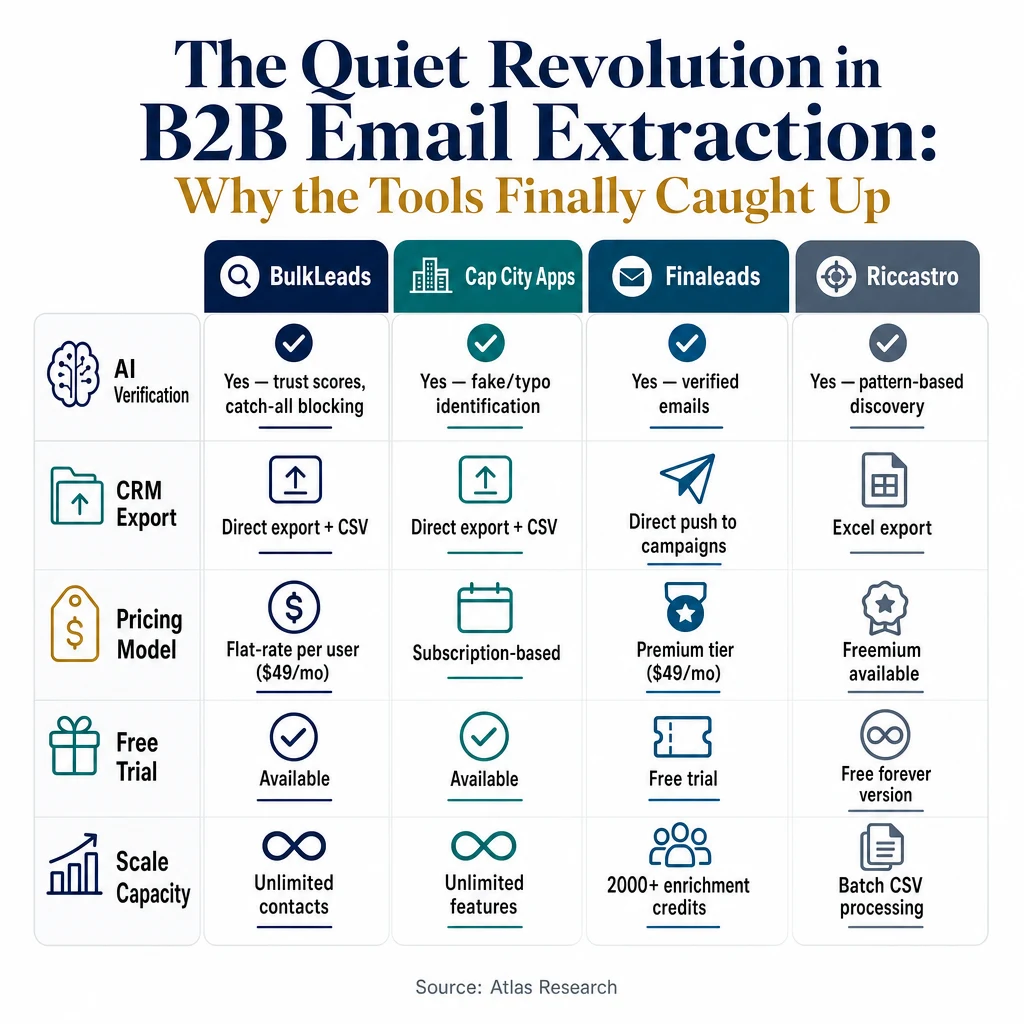
| Capability | BulkLeads | Cap City Apps | Finaleads | Riccastro |
|---|---|---|---|---|
| AI Verification | Yes - trust scores, catch-all blocking | Yes - fake/typo identification | Yes - verified emails | Yes - pattern-based discovery |
| CRM Export | Direct export + CSV | Direct export + CSV | Direct push to campaigns | Excel export |
| Pricing Model | Flat-rate per user ($49/mo) | Subscription-based | Premium tier ($49/mo) | Freemium available |
| Free Trial | Available | Available | Free trial | Free forever version |
| Scale Capacity | Unlimited contacts | Unlimited features | 2000+ enrichment credits | Batch CSV processing |
The Contrarian Takeaway
The conventional wisdom says B2B email extraction is risky, inaccurate, and legally questionable. The contrarian view, supported by how these tools actually function in 2026, suggests something different: the technology has matured, the legal landscape is more nuanced than the warnings suggest, and the integration capabilities have made these tools viable as primary outbound infrastructure more than backup tactics.
The sales director at the beginning of this article had three bad options three years ago. Today she has a fourth: use an AI-powered extraction tool that finds, verifies, and exports email addresses directly to her CRM, with trust scores that tell her which contacts are most likely to engage. The revolution isn't loud. It's quiet, integrated, and already running in the background of thousands of B2B sales operations.